m7 Piano Chords
m7 is especially useful as ii7 before a dominant and as a minor or modal tonic. Its lowered third also keeps it distinct from Dominant 7.
m7 structure, shown with C
Cm7 is C–E♭–G–B♭: a C minor triad plus the minor seventh B♭. Its minor third E♭ distinguishes it from the dominant-seventh quality of C7.
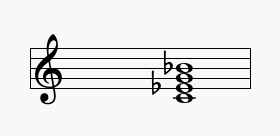
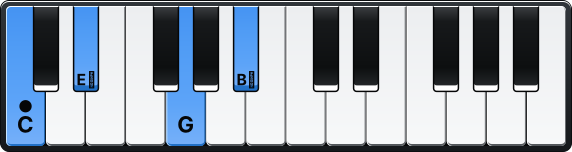
What m7 quality means
Minor seventh is a quality, not a fixed function. The same Cm7 can be predominant in B♭ major or tonic in C minor and modal music.
m7 in harmonic context
These examples place Cm7 in the two especially useful roles of predominant ii7 and minor tonic i7.
Hear the minor third and seventh
Cm7 → C7
- Common tones
- C · G · B♭
- Moving voice
- E♭ → E
E♭ moves up a semitone to E, while C and G and B♭ remain as common tones.
m7 chord symbols
Cm7, Cmin7, Cmi7 and C−7 are common spellings. CmMaj7 is different because it contains B natural rather than B♭.
m7 and half-diminished are different
Cm7 has the perfect fifth G. Cm7♭5 lowers that note to G♭, producing the half-diminished seventh quality.