aug Piano Chords
Aug raises the fifth of a major triad and often sends that note up by one more semitone. Its symmetry also lets three written roots share the same piano keys.
Augmented structure, shown with C
Caug is C–E–G♯. Two stacked major thirds create the symmetric 0–4–8 structure, with G♯ forming an augmented fifth above C.
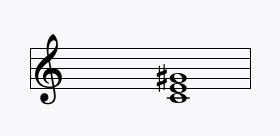
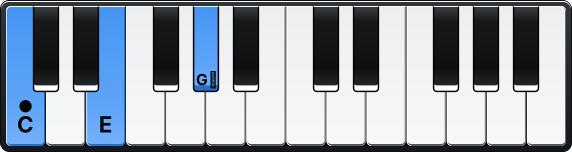
What augmented quality means
Because the pitch-class set is symmetrical, Caug, Eaug and G♯aug can use the same piano keys enharmonically. Spelling and context identify the intended root.
Augmented triads in harmonic context
These examples show the raised fifth continuing by semitone and the augmented triad connecting closely related harmonies.
Hear the raised fifth move
Caug → C
- Common tones
- C · E
- Moving voice
- G♯ → G
G♯ moves down a semitone to G, while C and E remain as common tones.
Aug chord symbols
Caug and C+ name the augmented triad. C7♯5 is different because it also includes the minor seventh B♭.
A symmetrical chord with contextual roots
Caug, Eaug and G♯aug are enharmonically the same piano-key collection, but their spellings are not interchangeable in harmonic analysis.